The Miracle on the Hudson: The Technical Story of Flight 1549
US Airways Flight 1549 became one of aviation’s most important safety case studies after a bird strike caused the loss of both engines. This technical analysis examines aircraft performance, aerodynamics, flight controls, crew decision-making, ditching and the safety lessons that followed.
The Miracle on the Hudson: A Technical Analysis of US Airways Flight 1549
How bird ingestion, dual-engine thrust loss, aircraft systems, human factors and emergency decision-making turned US Airways Flight 1549 into one of the most important aviation safety case studies in modern history
On January 15, 2009, US Airways Flight 1549 departed New York's LaGuardia Airport for Charlotte Douglas International Airport. Less than two minutes after takeoff, the Airbus A320-214 encountered a large flock of Canada geese at approximately 2,800 feet above ground level.
Within seconds, the aircraft suffered an almost complete loss of thrust from both engines.
The situation presented the crew with an extremely unusual combination of problems: low altitude, high workload, almost no available propulsion, limited time, and no conventional runway within immediate reach.
Captain Chesley "Sully" Sullenberger and First Officer Jeffrey Skiles ultimately ditched the aircraft on the Hudson River. All 155 people aboard survived the accident, although several occupants suffered serious injuries.
The event became known as the "Miracle on the Hudson."
From an aviation engineering and safety perspective, however, the most important question is not simply how the aircraft landed on the river.
The more important question is:
Why was the aircraft still controllable, why did the crew choose the Hudson River, and why did the combination of aircraft design, crew resource management, emergency procedures and response infrastructure produce a survivable outcome?
The NTSB concluded that the probable cause was the ingestion of large birds into both engines, resulting in an almost total loss of thrust and the subsequent ditching. The investigation also identified important shortcomings involving training, ditching certification, emergency checklists, engine bird-ingestion certification and wildlife hazard mitigation.
1. The Aircraft and the Initial Flight
Flight 1549 was operated by an Airbus A320-214 powered by two CFM56-5B4/P turbofan engines.
The aircraft had five crewmembers and 150 passengers, including one lap-held child.
Weather conditions were favorable. Visibility was approximately 10 miles and there were no significant meteorological obstacles to the flight.
The accident therefore did not begin as a conventional weather-related emergency.
It began with a biological hazard.
Approximately two minutes after departure, the aircraft encountered a flock of large birds.
The resulting bird strike was unusual in both scale and circumstances.
The aircraft was approximately 2,800 feet above ground level, significantly higher than the altitude at which most reported bird strikes occur. The FAA notes that approximately 71 percent of reported bird strikes occur below 500 feet, while the Flight 1549 encounter occurred at approximately 2,800 feet.
Multiple large Canada geese entered both engine systems.
This distinction is important.
A bird strike does not automatically mean an engine will stop producing thrust. Turbofan engines are designed and certified to tolerate defined levels of bird ingestion.
Flight 1549 encountered a threat that was substantially different from the assumptions underlying the certification environment at the time.
2. What Happens When a Large Bird Enters a Turbofan?
A modern turbofan contains several major aerodynamic and mechanical sections.
Air enters through the fan, where a large amount of airflow is accelerated. Part of the flow passes through the engine core, where compressor stages increase pressure before combustion.
When a large bird enters the engine, it is not simply "cut into pieces."
The ingestion produces a complex combination of:
- aerodynamic disturbance,
- foreign-object damage,
- compressor blade deformation,
- possible compressor stall,
- airflow disruption,
- core damage,
- combustion instability,
- and major thrust reduction.
The Flight 1549 engines exhibited extensive evidence of soft-body impact and organic material.
The bird remains were subsequently identified through DNA analysis as Canada geese.
The critical issue was that birds entered both engines.
A twin-engine transport aircraft is fundamentally designed around the assumption that the loss of one engine can be managed.
The simultaneous loss of effective thrust from both engines is an entirely different problem.
3. Why Losing Both Engines at 2,800 Feet Was So Dangerous
Aircraft do not immediately fall out of the sky when their engines stop producing thrust.
This is one of the most important aerodynamic concepts for understanding Flight 1549.
An aircraft in flight possesses energy in two major forms:
Potential energy — primarily altitude.
Kinetic energy — primarily airspeed.
When thrust disappears, the aircraft can exchange altitude for airspeed and continue flying as a glider.
The problem is that the aircraft is now consuming its available energy.
Without sufficient altitude, there is only a limited amount of time available to:
- diagnose the emergency,
- select a landing location,
- configure the aircraft,
- establish the correct flight path,
- communicate with air traffic control,
- and execute the landing.
Flight 1549 therefore became an energy-management problem.
The pilots were no longer primarily trying to "fly to an airport."
They were trying to determine where the remaining aircraft energy could be converted into a survivable landing.
4. The Problem With Simply Returning to LaGuardia
One of the most misunderstood aspects of Flight 1549 is the assumption that the pilots simply "could have turned around."
A return to LaGuardia required more than turning the aircraft toward the airport.
The aircraft had to:
- maintain sufficient airspeed,
- complete the turn,
- avoid excessive altitude loss,
- align with a usable runway,
- and reach the runway before the available energy was exhausted.
At low altitude and without engine thrust, every maneuver had an energy cost.
The NTSB concluded that the captain's decision to ditch on the Hudson River rather than attempt to reach an airport provided the highest probability that the accident would be survivable.
This is a critical example of decision-making under extreme time pressure.
The theoretically closest airport is not necessarily the safest reachable landing site.
5. Aircraft Control Without Engine Thrust
The A320 remained aerodynamically controllable after the thrust loss.
This is because aircraft control surfaces do not require the engines to produce forward thrust in order to generate aerodynamic forces.
The wings continued producing lift.
The elevators continued controlling pitch.
The rudder remained available for yaw control.
The ailerons and associated flight-control systems continued to provide roll control.
The aircraft's flight-control architecture was therefore crucial.
The A320 uses a fly-by-wire flight-control system in which pilot commands are transmitted electronically to flight-control computers.
The aircraft also incorporates flight-envelope protections designed to prevent certain aerodynamic conditions.
These protections became particularly relevant during the final approach.
According to FAA findings, the captain's difficulty maintaining the intended airspeed during the final approach resulted in a high angle of attack, which contributed to difficulties during the flare and a high descent rate at touchdown.
This illustrates a subtle but important engineering point:
Keeping an aircraft controllable is not the same as making the aircraft easy to control.
The aircraft remained flyable, but the margin for error was extremely small.
6. Airspeed, Angle of Attack and Energy Management
Aviation students often learn that maintaining airspeed is one of the fundamental priorities during an engine-out glide.
This became critical during the Hudson approach.
If the aircraft flies too slowly, angle of attack increases.
If the aircraft flies too fast, excess kinetic energy may be converted into a higher descent rate or may make the aircraft more difficult to configure for touchdown.
The pilots therefore had to manage a narrow energy envelope.
The final approach was particularly difficult because the aircraft had no engine thrust available to compensate for energy losses.
In a normal landing, the pilot can adjust thrust to influence the aircraft's energy state.
During the Hudson ditching, that option did not exist.
Every correction therefore had to be made primarily through aircraft attitude and configuration.
7. The Role of the A320 Flight-Control System
The A320's flight-control architecture was another important part of the accident.
Fly-by-wire systems allow computers to interpret pilot commands and manage the aircraft's flight-control surfaces.
This does not mean that the computer "flew the airplane by itself."
The crew still had to make the strategic decisions.
The computers provided a control architecture within which the aircraft could be maneuvered.
The distinction is important:
Automation can control an aircraft, but it cannot decide where the aircraft should land.
The Flight 1549 crew faced a problem that was fundamentally strategic rather than merely mechanical.
There was no automated system that could simply calculate the entire solution and guarantee a safe landing.
8. Crew Resource Management Under Extreme Workload
The cockpit environment during the accident was highly dynamic.
The crew had to simultaneously:
- diagnose the engine failure,
- attempt engine relights,
- evaluate landing options,
- communicate with ATC,
- configure the aircraft,
- and maintain control.
This created an enormous workload.
The NTSB specifically identified the flight crew's decision-making and crew resource management as factors contributing to survivability.
Crew Resource Management, or CRM, is sometimes misunderstood as simply "good communication."
It is much broader.
CRM includes:
- task allocation,
- situational awareness,
- cross-checking,
- communication,
- prioritization,
- workload management,
- decision-making,
- and error detection.
In an emergency, CRM becomes a form of risk management.
The pilots did not have to eliminate the emergency.
They had to manage it well enough to keep the aircraft controllable.
9. The Importance of Checklists—and Their Limitations
One of the most important lessons from Flight 1549 concerns emergency checklists.
The crew did not have a checklist specifically optimized for a low-altitude, dual-engine failure immediately after takeoff.
Existing procedures were designed around different assumptions.
The FAA notes that the dual-engine failure training and checklist philosophy was strongly influenced by the assumption that such failures would occur at higher altitudes, where crews would have substantially more time to diagnose and respond.
Flight 1549 challenged that assumption.
An emergency checklist can be technically correct and still be operationally unsuitable if the crew does not have enough time to execute it.
This is an important human-factors principle:
A checklist must match the temporal characteristics of the emergency.
A ten-minute procedure is of limited value when the aircraft may impact terrain or water within minutes.
10. Why the Hudson River Was Survivable
Ditching an airliner into water is an extremely hazardous maneuver.
The objective is not to "land on water" in the same way an aircraft lands on a runway.
The objective is to control:
- aircraft attitude,
- speed,
- descent rate,
- touchdown geometry,
- and structural loads.
Water is not a soft landing surface.
At high speed, water can impose substantial deceleration forces.
The aircraft's fuselage and wings therefore become part of the survival equation.
The A320 remained sufficiently intact after the impact for occupants to evacuate.
However, the aircraft was substantially damaged.
The NTSB specifically noted that the captain's difficulty maintaining intended airspeed contributed to a high angle of attack, difficulties during the flare, and a high descent rate at touchdown, which contributed to fuselage damage.
The success of the ditching should therefore not be interpreted as evidence that water landings are inherently safe.
It was a highly unusual survivable outcome.
11. The Role of Flaps and Aircraft Configuration
One interesting technical decision involved the use of flap configuration during the ditching.
The captain selected Flaps 2.
Flaps increase wing lift at lower speeds but also increase drag.
In a powerless aircraft, drag becomes especially important because there is no engine thrust available to replace the lost energy.
The crew therefore had to balance:
lower approach speed vs. increased drag
and
higher approach speed vs. increased impact energy.
FAA findings concluded that the decision to use Flaps 2 was reasonable given the circumstances and consistent with the limited guidance available at the time.
This illustrates why emergency aviation decisions cannot always be judged by normal operating procedures.
A configuration that makes sense during a conventional runway landing may have different consequences during a powerless ditching.
12. Why the Engines Did Not Simply "Fail Normally"
Flight 1549 also exposed an important weakness in the industry's assumptions regarding bird ingestion.
The CFM56 engines were certified according to the requirements applicable at the time.
The FAA explains that large-bird certification testing involved defined test conditions and that the accident involved a substantially different scenario: multiple large birds entering the cores of both engines.
The FAA later examined ways to make bird-ingestion certification more representative of the threat.
One proposed approach involved testing at conditions representing lower fan speeds associated with climb rather than relying only on high-power takeoff conditions.
The objective was to better represent the possibility of bird material entering the engine core during climb.
This is an important engineering lesson:
Certification is based on defined threat models.
If the real-world threat evolves beyond those assumptions, certification standards must evolve as well.
13. The Human-Factors Paradox
Flight 1549 presents an interesting paradox.
The aircraft was highly automated.
Yet the successful outcome depended heavily on human decision-making.
Automation provided control capability.
The crew provided:
- judgment,
- prioritization,
- interpretation,
- risk assessment,
- and strategic decision-making.
This distinction remains relevant to modern aviation.
More automation does not eliminate the need for pilots.
Instead, it changes the nature of the pilot's job.
As aircraft systems become increasingly sophisticated, pilots increasingly act as systems managers and decision-makers during abnormal situations.
14. Cabin Crew and Evacuation
The accident did not end when the aircraft touched the Hudson.
Survival required a successful evacuation.
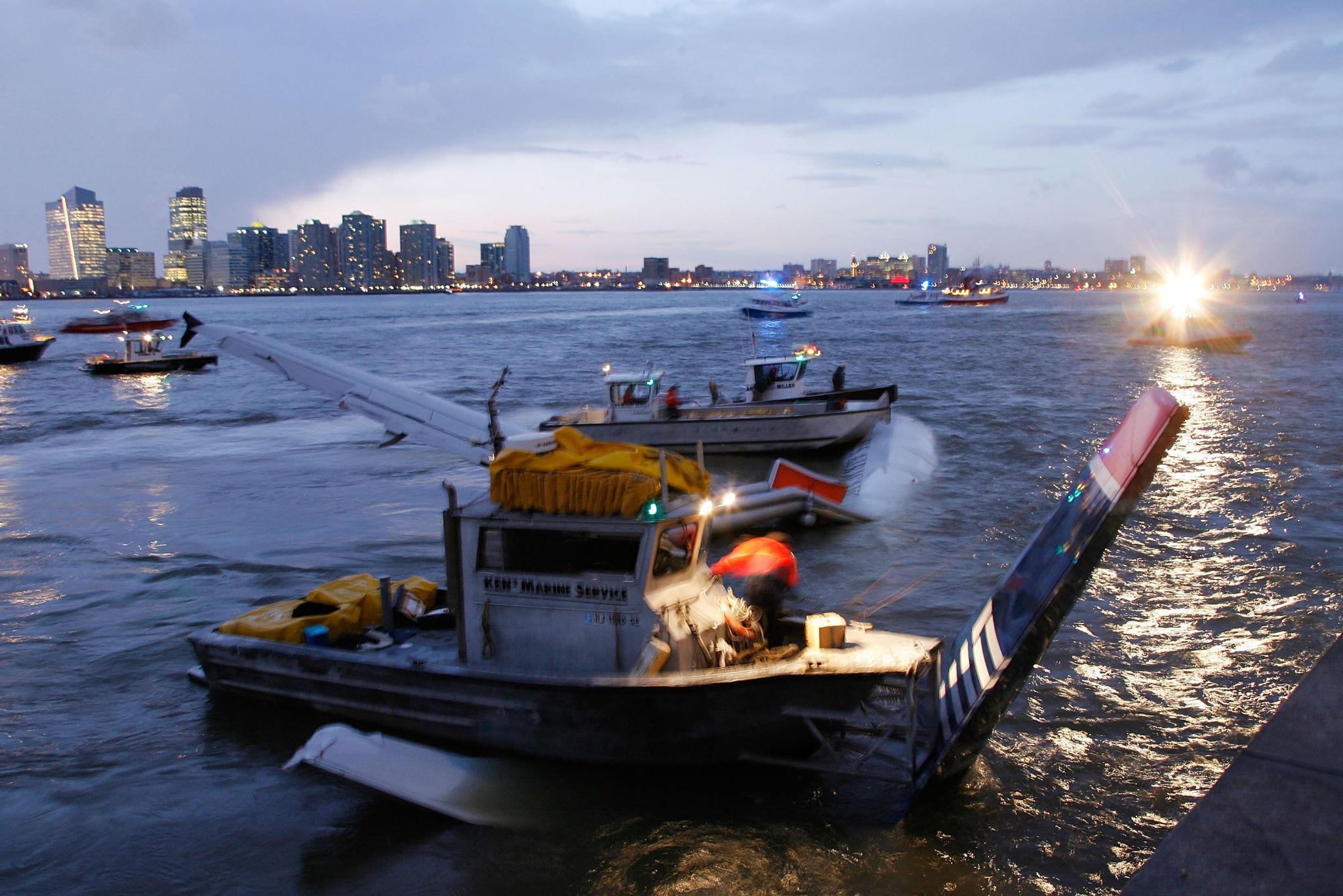
The aircraft remained afloat long enough for occupants to exit through the forward and overwing exits.
The NTSB identified cabin-crew performance as a factor contributing to survivability. It also noted the importance of the aircraft's equipment and the availability of forward slide/rafts.
This is a critical reminder that aviation safety is a system.
A successful emergency outcome does not depend solely on the cockpit.
It involves:
aircraft → pilots → cabin crew → ATC → airport infrastructure → emergency responders.
A failure in any one of these layers can change the outcome.
15. The Emergency Response System
The Hudson River location provided another unexpected advantage.
Emergency responders and nearby vessels were able to reach the aircraft quickly.
The NTSB specifically identified the proximity and immediate response of emergency responders as contributing factors to survivability.
The accident therefore demonstrates the importance of the final layer of aviation safety:
rescue and survivability.
Preventing an accident is always preferable.
But when prevention fails, the aviation system must still maximize the probability that people survive.
16. What the Accident Changed
The NTSB issued 34 new safety recommendations following the investigation, addressing areas including:
- engine bird-ingestion certification,
- emergency checklists,
- dual-engine failure training,
- ditching training,
- flight-control response,
- wildlife hazard mitigation,
- cabin safety equipment,
- and emergency procedures.
The investigation also challenged the assumption that a bird strike would normally affect only one engine.
Multiple large birds entered both engine cores in this accident.
That was a key reason the event became such an important safety case.
17. The Broader Engineering Lesson
The deepest lesson from Flight 1549 is not that an Airbus A320 can glide without engines.
Aircraft have always been capable of gliding.
The deeper lesson is that aviation safety is based on layers of protection.
Each layer has limitations.
The engine certification standards had limitations.
The wildlife mitigation system had limitations.
The emergency checklist had limitations.
The available training had limitations.
The aircraft's performance had limitations.
Yet the layers interacted favorably enough to produce a survivable outcome.
This is closely related to the broader concept of accident prevention through multiple independent safety barriers.
18. Was It Really a Miracle?
Calling Flight 1549 the "Miracle on the Hudson" is understandable.
But from a technical perspective, the word "miracle" can hide the engineering and human factors behind the outcome.
The successful ditching was the product of several interacting elements:
Aircraft controllability
Crew Resource Management
Pilot experience
Rapid decision-making
Cabin crew performance
Aircraft structural integrity
Emergency equipment
Immediate rescue response
The event contained a significant element of luck.
But luck alone does not explain the outcome.
The aircraft still had to be controlled.
The crew still had to make decisions.
The cabin still had to be evacuated.
And the emergency response system still had to function.
Conclusion
US Airways Flight 1549 remains one of the most valuable aviation safety case studies of the modern era because it sits at the intersection of engineering, aerodynamics, human factors and operational decision-making.
The accident began with a threat that the aircraft was never expected to encounter in exactly that combination: a large flock of birds entering both engines at low altitude.
The resulting loss of thrust transformed a routine departure into an energy-management emergency.
The aircraft remained controllable, but the available time and altitude were extremely limited.
The crew had to make a decision before every possible option disappeared.
The decision to ditch on the Hudson was not simply an act of bravery. It was a high-stakes operational decision based on the aircraft's remaining energy, geographic constraints and rapidly deteriorating situation.
The investigation subsequently revealed that the industry also had lessons to learn.
Bird-ingestion certification, emergency checklists, dual-engine failure training, ditching procedures and wildlife hazard mitigation all came under renewed scrutiny.
Perhaps the most important lesson is therefore not that pilots can perform miracles.
It is that well-designed aircraft, trained crews, effective procedures and resilient safety systems can turn an otherwise catastrophic chain of failures into a survivable event.
Flight 1549 was extraordinary not because aviation safety systems worked perfectly.
It was extraordinary because, despite several limitations, enough of those systems worked together when they were needed most.